
Owe More on Your Car Than It's Worth? Here's What to Do
What It Means to Be Underwater
 What It Means to Be Underwater
You are underwater — or upside-down — when you owe more on your car loan than the car is currently worth. This is not unusual. It is a predictable consequence of depreciation outpacing a loan balance that decreases slowly, especially in the early years of a long-term loan.
Example: you financed $28,000 on a 72-month loan three years ago. The car is now worth $18,000. Your loan balance is $19,500. You are $1,500 underwater — meaning a sale today would not fully pay off the loan. The $1,500 does not disappear. It has to come from somewhere.
- Check your loan payoff amount: call your lender or check online — this is different from your current balance and accounts for any prepayment terms
- Check your car's current market value: Carvana instant offer, CarMax appraisal, and KBB Private Party Value — average them
- The difference between the payoff amount and the market value is your negative equity
- Negative equity is most common in years 1–3 of a long-term loan on a vehicle with normal depreciation
Four Exits. None Painless.
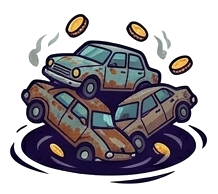 Four Exits. None Painless.
You have four paths. None of them are painless — but they are not equivalent. The Witch will be clear about what each one actually costs.
1. Keep the car and pay down the loan
If the car is mechanically sound and the payment is manageable, staying put and making extra principal payments is often the cheapest path. It clears the negative equity without forcing you to cover the gap out of pocket right now. The question is whether the car will stay reliable long enough to reach positive equity — and whether the maintenance cost of keeping it is justified.
2. Sell privately and cover the gap in cash
A private sale maximizes your sale price — which minimizes the gap you have to cover. If you owe $19,500 and can sell privately for $20,000 instead of $17,500 at wholesale, that $2,500 difference may flip you from underwater to a small surplus. The coordination required is more complex (more on this below), but the financial outcome can be materially better.
3. Trade in and roll the negative equity
This is the option the Witch specifically cautions against. Rolling negative equity into a new loan means you are financing the loss — plus interest — on top of the new purchase. You start day one underwater again, and you've compounded the problem. The monthly payment may look manageable. The total cost is not.
4. Refinance to reduce the rate
If your credit has improved since you took out the original loan, refinancing at a lower rate does not reduce the negative equity — but it reduces the total interest paid while you work down the balance. It is not an exit. It is a cost-reduction measure for option 1.
If private sale is your route, the lien is the part that trips people up. Here's how to handle it.
Coordinating a Private Sale When You Have a Lien
 Coordinating a Private Sale When You Have a Lien
Selling a car with an outstanding loan is more complex than a clean-title sale — but it is not difficult if you understand the mechanics. Buyers are generally wary of purchasing a car with a lien, which is why transparency and process matter here.
The title is held by your lender until the loan is paid off. That means you cannot simply hand over a title at the sale. You need to coordinate the payoff and title release as part of the transaction.
The most common method
- Get your exact payoff amount from your lender — valid for a specific number of days
- Arrange to meet at your lender's branch, or at a branch where the buyer can verify a cashier's check payable to the lender
- Buyer pays the lender directly (up to the payoff amount), and pays any remaining balance to you
- Lender releases the title, either immediately or by mail within 10–14 business days depending on the lender
- Some credit unions will hold the buyer's payment in escrow until the title is released — call your lender in advance to understand their process
If you're underwater
- You cover the gap from savings — the buyer pays the car's market value, and you pay the difference to the lender yourself
- This requires having the cash available at closing — coordinate with your bank in advance
- Some lenders will allow you to pay the gap online before the sale so the title is clear by transaction day — ask
The Math on Rolling Negative Equity
 The Math on Rolling Negative Equity
The Witch will be specific, because vague warnings are easy to dismiss.
You are $3,000 underwater. The dealer offers to roll that $3,000 into your new loan. Your new loan is $24,000 at 8% APR for 60 months. Of that $24,000, $3,000 is debt you already owed — not a car. Your effective borrowing cost on that $3,000 alone, financed at 8% for 60 months, is approximately $660 in interest. You paid $660 to delay a $3,000 loss by five years.
The new car also starts depreciating immediately. In 12 months, it may be worth $2,000–$4,000 less than what you paid — on top of the $3,000 you started underwater. The cycle repeats.
- Ask yourself: what is the total amount I will owe on day one of the new loan, including rolled equity?
- What is the new car's estimated value in 12 months? In 24 months?
- At what point do you cross from underwater to positive equity — and is the car likely to remain reliable until that point?
- What would it cost to cover the gap in cash today versus financing it over the loan term?